
The country's foreign exchange reserves swelled by $1.013 billion to touch a lifetime high of $610.012 billion in the week ended July 2, RBI data showed on Friday. In the previous week ended June 25, 2021, the reserves had jumped by $5.066 billion to reach $608.999 billion. During the reporting week, the rise in the forex kitty was mainly on account of an increase in foreign currency assets (FCA), a major component of the overall reserves.

"The Executive Board will meet with the candidates in Washington and, thereafter, meet to discuss the strengths of the candidates and make a selection," the official IMF statement said.

The country's foreign exchange reserves declined by $763 million to $640.11 billion in the week ended November 12, RBI data showed. In the previous week ended November 5, the reserves had decreased by $1.14 billion to $640.87 billion. It touched a lifetime high of $642.45 billion in the week ended September 3, 2021.

India remains the largest growing economy in the world, a senior official from the International Monetary Fund said, observing that the country's macroeconomic fundamentals are good. "India is said to remain the largest growing economy in the world. We project growth at seven per cent in FY24-25, supported by recovery in rural consumption, as there have been favourable harvests.

The country's foreign exchange reserves surged by $5.066 billion to touch a record high of $608.999 billion in the week ended June 25, 2021, RBI data showed. In the previous week ended June 18, the reserves had declined by $4.418 billion to $603.933 billion. During the week under review, the increase in the forex reserves was on account of a rise in foreign currency assets (FCA), a major component of the overall reserves, Reserve Bank of India's (RBI) weekly data showed.
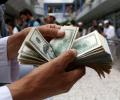
The country's foreign exchange reserves rose by $758 million to reach a record high of $586.082 billion in the week ended January 8, RBI data showed on Friday. In the previous week ended January 1, the reserves had increased by $4.483 billion to $585.324 billion.

Sliding from a lifetime high, India's forex reserves declined by $4.148 billion to reach $603.933 billion for the week ended June 18 due to a fall in gold and currency assets, RBI data showed on Friday. The forex kitty had surged by $3.074 billion to a record high of $608.081 billion in the previous reporting week. The foreign currency assets (FCA), a major component of the overall reserves, declined by $1.918 billion to $561.540 billion for the reporting week, as per data by the Reserve Bank of India (RBI).
'Nations like India with high inflation and public debt should be cautious'
International Monetary Fund managing director Dominique Strauss-Kahn on Thursday said he favoured new heads of the World Bank and the Fund to be from countries other than Europe and the United States.
The multilateral lending agency, however, expressed concern over rising prices and underlined the need

The International Monetary Fund has said that it would be prudent to gain sufficient experience by implementing a comprehensive framework before deciding on the entry of 'mixed groups and conglomerates' into commercial banking.

The areas for improvement include greater de jure independence of regulatory agencies, consolidated supervision of financial conglomerates and reductions in the large exposures and related-party lending limits in banks.

It will be the second Budget of the Modi 3.0 government and eighth straight Budget for Nirmala Sitharaman, rare in Indian polity.

Pointing out that global economy continues to vulnerable, the declaration issued at the end of the two-day G-20 summit in Los Cabos said, "this effort (to provide $450 billion to the IMF) shows the G-20 and the international community's commitment to take the steps needed to safeguard global financial stability and enhance the IMF's role in crisis prevention and resolution."
The United States continues to remain the world's largest economy.
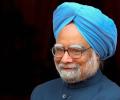
Former Prime Minister Manmohan Singh's 1991 budget unshackled India's economy, significantly enhancing the economic prospects for hundreds of millions of Indians, first deputy managing director of the International Monetary Fund (IMF) Gita Gopinath said on Friday.

The country's foreign exchange reserves rose by $2.04 billion to $639.52 billion in the week ended October 8, according to RBI data. In the previous week ended October 1, the reserves had dipped by $1.17 billion to $637.48 billion. The reserves had surged by $8.90 billion to a life time high of $642.45 billion in the week ended September 3.

At the IMF, India is expected to link announcement of additional resources to the IMF to the implementation of 2012 quota reform.

The country's foreign exchange reserves dipped by $1.17 billion to stand at $637.48 billion in the week ended October 1, RBI data showed on Friday. In the previous week ended September 24, 2021, the reserves had declined by $997 million to $638.65 billion. The reserves had surged by $8.90 billion to a lifetime high of $642.45 billion in the week ended September 3, 2021.

A Chinese Navy warship capable of surveillance has docked at the Colombo port, nearly a year after another spy vessel berthed at a strategic port in the country and raised concerns in India.
It will take a period of time to recover back to the higher levels that India enjoyed in previous years, IMF director said.
The Bush administration voted for the Canadian candidate instead of Chidambaram, who till end of September had been the front-runner to head the IMF's influential Monetary and Financial Committee.
To avoid it, the economies need to improve govt institutions and liberalise rigid labour markets.

The country's foreign exchange reserves declined by $997 million to reach $638.646 billion in the week ended September 24, RBI data showed on Friday. In the previous week ended September 17, 2021, the reserves had tumbled by $1.47 billion to $639.642 billion. The forex kitty had surged by $8.895 billion to a lifetime high of $642.453 billion in the week ended September 3, 2021.
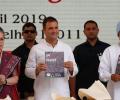
'Mrs Gandhi had nothing to do in the day-to-day working of Dr Singh's government.' 'People say Mrs Gandhi's office used to give orders, which is nonsense.'

The country's foreign exchange reserves rose $183 million to touch a record high of $560.715 billion in the week ended October 30, RBI data showed on Friday. In the previous week ended October 23, the reserves had jumped $5.412 billion to $560.532 billion.
Pranab said he had clarified this issue in no uncertain terms with US Treasury Secretary who had brought up this issue during bilateral talks.

The Financial Intelligence Unit-India (FIU-India), the national agency responsible for analysing suspicious financial transactions, has received requests from four more offshore crypto exchanges to operate in India again, said a senior government official familiar with the matter. In the beginning of 2024, India had banned nine crypto exchanges - Binance, Kucoin, Huobi, Kraken, Gate.io, Bitstamp, MEXC Global, Bittrex, and Bitfenix - for non-compliance with anti-laundering law in the country.

The country's foreign exchange reserves grew by $2.23 billion to $634.96 billion in the week ended January 14, RBI data showed. In the previous week ended January 7, the reserves had declined by $878 million to $632.74 billion. It touched a lifetime high of $642.45 billion in the week ended September 3, 2021.

India will soon allow corporate houses to open banks despite misgivings within the RBI.
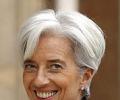
Lagarde said that she had elaborate discussions on the general economic situation.

A third of the global economy will be in recession this year, the IMF chief has said, and warned that 2023 will be "tougher" than last year as the US, EU and China will see their economies slow down. Kristalina Georgieva, the chief of the International Monetary Fund (IMF) made these grim assertions on Sunday during a CBS news programme "Face the Nation." It comes at a time when the ongoing conflict in Ukraine shows no signs of abating after more than 10 months, with spiralling inflation, higher interest rates and the surge in coronavirus infections in China fuelled by the Omicron variant.

The IMF's Financial System Stability Assessment Update said India had improved its supervision and regulations in the 20 years since it started liberalising its economy and that its financial system fared well in the global financial crisis.
International Monetary Fund Managing Director Rodrigo de Rato will quit the Fund in October without completing his five-year term which ends in May 2009.
Gold reserves rose by $320 million to $31 billion.
IMF has predicted a slowdown of world economic growth and approves of Fed Reserve's move of cutting its interest rate.
Asia has more than one candidate who fits the bill.

Crypto assets should not be granted official currency or legal tender status, the much-awaited synthesis paper by the International Monetary Fund (IMF) and Financial Stability Board (FSB) has said ahead of the G20 leadership summit under India's presidency. However, the report has argued against a blanket ban on activities linked to crypto assets, explaining that such a move can be costly as well as technically demanding to enforce. Central banks should avoid holding crypto assets in their official reserve as they pose a risk to monetary and global financial stability, according to the synthesis paper.

Inflation, which has been at high levels, is also a key challenge for the country, Thomas J Richardson, the IMF's Senior Resident Representative in India and Nepal, said in New Delhi on Wednesday.
The scramble for International Monetary Fund managing director's chair has escalated into a war of sorts with developing nations calling for a change in the power equation.
